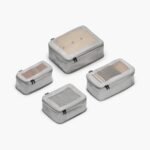
For trips in the United States, the best compression packing cubes are the ones that fit your suitcase, hold the clothes you pack most, and close without strain. Thule Compression Packing Cubes are a strong all-around option; Eagle Creek Pack-It Isolate Compression Cubes suit travelers who want a simple, light set; and Peak Design Packing Cubes stand out for separating clean and worn clothes. The right pick depends on your bag and how you pack.
Compression cubes can make clothes take up less room, but they do not make your bag lighter. Airline size and weight limits still apply, and limits vary by airline and fare. The product notes below are based on documented designs, not hands-on testing; models and listings can change, so check current details before buying.

Best compression packing cubes: three useful picks
There is no single best set for every traveler. These picks match different packing needs, and none should be read as a lab-tested ranking.
| Pick | A good fit for | Main draw | Trade-off |
|---|---|---|---|
| Thule Compression Packing Cube | Travelers who want a simple two-cube setup | A purpose-built compression design from an established travel-gear brand | Check the current set contents and dimensions; “two-cube set” does not mean both cubes fit every suitcase |
| Eagle Creek Pack-It Isolate Compression Cube Set | Travelers who want a basic, light packing system | A straightforward compression-cube design | A simple set may not offer features such as a divider for worn clothes |
| Peak Design Packing Cube | Travelers who want to separate clean and worn clothes | A divider helps keep those clothes apart; a second zipper compresses the cube | Extra organization can add cost or features you may not need |
Choose Thule for a simple, balanced place to start. Its compression cube is designed for the job: packing clothes and closing a second zipper to reduce the cube’s bulk. Check the current product listing for sizes, materials, and what is included, since these details can change.
Choose Eagle Creek for a no-fuss option. The Pack-It Isolate Compression Cube Set is a purpose-built set from a brand focused on travel organizers. It may suit you if you want compression without a laundry divider or a more complex layout.
Choose Peak Design if clean-and-worn separation matters. Its Packing Cube uses a divider to separate clothes and a compression zipper to reduce bulk. That extra feature is useful on longer trips, but it may not be worth paying for if you only pack clean clothes in cubes.
These are starting points, not proof that one cube lasts longer or compresses more than another. Compare current dimensions, materials, warranty terms, and price before you decide.

What compression packing cubes do—and what they do not do
A compression packing cube is a fabric pouch with a main zipper and a second zipper that pulls the packed fabric closer together. The main zipper closes the cube around your clothes. The compression zipper reduces the space the cube takes up by pressing out some air between soft items.
Compression can help make a suitcase easier to organize, especially when you pack soft clothes such as T-shirts, underwear, or workout gear. It cannot shrink the fabric itself or reduce the weight of your items. A tightly packed cube may save room in one part of your bag, but it can also make other items harder to fit.
Compression cubes are not vacuum bags. They do not remove all the air, and they do not make a cube waterproof unless the product is specifically designed and labeled for that purpose. Treat them as organizers that can reduce bulk, not as a way to carry more weight or protect items from water.

How to choose the right compression packing cube
Start with your suitcase, not the cube’s product photos. Measure the space inside your bag, then compare it with the cube’s listed dimensions. Leave room for the bag’s shape, lining, and other items; a cube that matches the suitcase’s full width may be hard to place.
Use these features to narrow your options:
- Size and shape: Small cubes can hold socks, underwear, or shirts. Larger cubes can suit pants and bulkier clothes. Check both the packed cube dimensions and the space available in your bag.
- Closure design: Look for a main zipper and a separate compression zipper. The second zipper should close without a hard pull when the cube is packed as directed.
- Fabric and seams: A light fabric can keep the cube’s own weight low. Stronger-feeling fabric may appeal if you travel often, but fabric appearance alone does not prove long-term durability.
- Organization: A divider can keep clean and worn clothes apart. Mesh panels can help you see what is inside, while a simple solid cube may suit travelers who prefer less fuss.
- Set contents: Check how many cubes are included and whether they are the sizes you need. A larger set is not automatically better if some cubes go unused.
- Care and warranty: Read the care instructions and warranty terms. Do not assume a cube is machine-washable or covered for every type of damage.
If you are choosing between two sets, compare the dimensions and usable features first. A low price may be appealing, but it is less useful if the cubes do not fit your bag or the zippers are difficult to close.

How to pack and compress cubes without forcing the zipper
Pack similar items together, then close the main zipper before using the compression zipper. This makes it easier to spot an overfilled cube before you apply extra pressure.
- Sort clothes by use. Put tops, underwear, or workout clothes in separate cubes if that will make them easier to find.
- Fold or roll clothes loosely. Choose the method that lets you use the cube’s shape well. Tight rolling is not required.
- Fill the cube without stretching it. Leave enough room for the main zipper to close easily.
- Close the main zipper. If fabric catches, stop and move it clear of the zipper teeth.
- Close the compression zipper slowly. Use steady pressure. Do not yank the zipper or press hard on a bulging cube.
- Place the cube in your bag. Keep heavier items low and near the bag’s wheels when using a rolling suitcase.
A cube is packed well when both zippers close without a struggle and the cube fits in your bag without pushing the bag out of shape. If the compression zipper will not move, open it and remove some clothes. Forcing it can damage the zipper or seams.

Common mistakes and limits to keep in mind
Do not treat compression as a weight-saving tool. The same clothes weigh the same after compression. A fuller suitcase may also be harder to lift and may exceed an airline’s weight limit.
Do not pack by the cube’s outer dimensions alone. Suitcases are not always rectangular inside. Wheels, handles, and curved corners can reduce usable space, so leave room for the bag’s shape and other items.
Do not overfill a cube to make it smaller. A bulging cube can strain its zipper and seams. Compression is meant to reduce excess bulk, not force too many clothes into a small pouch.
Do not assume every cube protects clothes from spills. Fabric, zippers, and seams differ by product. Keep liquids in suitable leak-resistant bags and follow airline rules for carrying them.
Finally, remember that a compression cube can make a suitcase feel more organized without making packing unlimited. Check your airline’s current baggage rules before you travel, especially if you plan to use the extra space for more items.

Key takeaways
- Best simple starting point: Thule Compression Packing Cube.
- Best for a basic, light setup: Eagle Creek Pack-It Isolate Compression Cube Set.
- Best for separating clean and worn clothes: Peak Design Packing Cube.
- Compare cube dimensions with your suitcase before buying.
- Compression can save space, but it does not reduce weight.
- Close the zippers gently and remove items if they resist.
FAQs
Are compression packing cubes worth it?
They can be worth it if you want to reduce the bulk of soft clothes and keep items grouped. They may be less useful if you already pack light, use a small bag, or do not need extra organization.
Do compression packing cubes save luggage weight?
No. They reduce the space clothes take up by pressing out some air. They do not change the weight of the clothes or the cube.
Are compression cubes better than regular packing cubes?
Compression cubes can take up less space, but regular cubes may be easier to pack and close. Choose compression when saving space matters; choose regular cubes if simple sorting is enough.
Can I use compression packing cubes in a carry-on?
Yes, if the packed cubes fit inside your bag and the bag meets your airline’s current size and weight limits. Check the rules for your airline and fare, since limits vary.
How many compression cubes do I need?
Start with the number that fits your bag and your packing habits. One or two may be enough for a short trip; a larger set can help you sort clothes on a longer trip, but extra cubes can also take up room.
Bottom line
For most travelers comparing compression packing cubes, Thule is a sensible place to start, while Eagle Creek suits a simpler setup and Peak Design offers a useful clean-and-worn divider. Before buying, check the current product details and measure your suitcase. The best cube is the one that fits your bag, closes with ease, and helps you find what you packed.